top of page
Search

Hanfu Through the Ages: A Brief Overview of How Fashion Evolved in Ancient China

  • Feb 26
  • 6 min read
A timeline of women's clothing from the Qin Dynasty to the Qing Dynasty.

What is Hanfu?

Hanfu (汉服) is the traditional clothing of China’s dominant ethnic group, the Han (汉族). Nowadays, it refers to the various styles worn by the Han Chinese people over China’s millenia-long history, excluding the Qing Dynasty. (See my article “Is Qing Dynasty Clothing Hanfu?” for more information on why that is the case.)


Hanfu styles changed dramatically throughout the course of Chinese history, from the simple robes of the Shang and Zhou Dynasties, to the bold colors and elaborate designs of the Tang Dynasty, to the austere, pleated skirts of the Ming Dynasty. However, the broad strokes of this fashion style stayed relatively similar.


At its inception during the Shang Dynasty (1600 – 1046 BC), hanfu consisted of a simple, two-piece structure, not unlike modern clothes today—a cross-collar top, the yi (衣), and a skirt wrapped around it, the chang (裳). Combined, this was known as the yichang (衣裳), and both men and women wore this style. By the Zhou Dynasty (1046 – 256 BC), the defining ‘right over left’ rule of hanfu had been codified: cross-collar tops had to be tied ‘right over left’. The collars of hanfu must form a Y-shape when viewed from the front, a style known as jiaoling youren (交领右衽).

A diagram of a hanfu inner garment.

This custom likely originated for practical reasons, as right-handed people find it easier to place their left lapel over their right lapel. However, cultural reasons may have also played a role, since many ethnic groups in the Han Chinese people’s vicinity wore their clothes in the ‘left over right’ style and the Han Chinese wanted to distinguish themselves from the people around them.


Hanfu also consists of various types of headgear and hair accessories. Traditionally, Han Chinese men would wear their hair in a topknot and cover it with a cap once they came of age. A soft cap made of fabric was called a jin (巾), while more formal types of headwear were called guan (冠). In general, though, guan can be used nowadays as a catch-all term for hanfu headgear.
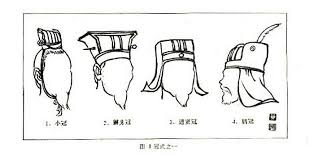
Various types of guan. From left to right: xiaoguan, faguan, ruguan, wuguan.

On the other hand, women would use a single-pronged hairpin, or ji (髻), to tie their hair in a bun once they came of age. A similar type of hairpin, the zan (簪), was more elaborately decorated and often featured carvings of plants, animals, or traditional Chinese patterns. In the modern day, the terms fazan (发簪) and zanzi (簪子) are used interchangeably to refer to the zan. Another common type of hairpin was the chai (钗), which had two prongs instead of the ji’s single one.

A zan that I wear with hanfu sometimes.

There are many, many more styles of headwear, but I’ll leave that for another day. Let’s get into the history of hanfu, shall we?


Zhou Dynasty

A new type of garment, the shenyi (深衣), was invented during the Zhou Dynasty. It was a one-piece garment, unlike the earlier yichang, and consisted of a top and bottom sewn together. By the Eastern Zhou Dynasty (771 – 256 BC), the shenyi had developed into the marker of a strict feudal hierarchy. Not unlike sumptuary laws in medieval Europe, the style of the shenyi was used to denote its wearer’s age and social status. It would continue to be a popular article of clothing during the succeeding Qin and Han Dynasties.

A man wearing shenyi.

Qin/Han Dynasties

By the Qin (221 – 206 BC) and Han (202 – 220 AD) Dynasties, a new style of hanfu known as paofu (袍服) had developed. Though it appeared similar to shenyi—also a single-piece garment wrapped entirely around the body—the two styles could be differentiated by their methods of construction. Whereas shenyi was created by cutting the top and bottom pieces from different bolts of fabric and sewing them together, paofu was made from a single section of fabric.

Ming Dynasty-style paofu.

During this period, the shenyi further developed into two types of clothing—the quju (曲裾) and the zhiju (直裾). The former consisted of a hemline that circled around levelly until reaching the bottom of the garment, creating a spiral shape, while the latter retained many features of earlier shenyi, such as a straight hemline. Both garments were originally gender-neutral, although after the Han Dynasty, the quju gradually came to be seen as a more feminine-coded style.

A diagram comparing quju and zhiju.

Three Kingdoms/Jin Dynasty

Women’s wear developed further after the Han Dynasty ended, resulting in the rise of ruqun (襦裙). As a type of yichang, the ruqun consisted of a shirt paired with a long skirt, with the ru being the shirt and the qun being the skirt. The ru often had wide sleeves, while the qun could be so long that it reached the floor. In succeeding dynasties, the ruqun would become very popular with the elites in Imperial China. Uniquely, the ruqun is that it could come in a variety of styles—the collar could be crossed in the traditional right-over-left style (交领), parallel (直领), or u-shaped (坦领). Men’s wear during this time did not change as drastically, but they retained the loose fit and wide sleeves characteristic of hanfu. That would begin to change in the next few centuries, though…

A modernized jiaoling ruqun on Taobao, a popular Chinese shopping app.
Modernized zhiling ruqun.
Tang Dynasty-style tanling ruqun on Taobao.

Tang Dynasty

Due to flourishing trade networks and relative stability, the Tang Dynasty (618 – 907 AD) is often considered the golden age of Imperial China. The dynasty expanded further west than any previous dynasty, bringing elements of Central Asian fashion into hanfu. The yuanlingpao (圆领袍), or round-collar robe, skyrocketed in popularity, becoming daily outerwear for men. Early forms of the robe were borrowed from non-Han Chinese people groups, such as the Xianbei, so they had narrow sleeves as opposed to hanfu’s wide ones. In later years, it would also become fashionable for women to wear yuanlingpao.

Yuanlingpao from Baidu Baike.

Previous dynasties, having Confucianism as their dominant belief system, had conservative fashions and clothing showed little skin. However, the Tang Dynasty was more influenced by foreign cultures and readily syncretized both belief systems and clothing styles. Women’s clothing became more loose and relaxed, with some paintings from the era depicting women with cleavage.


Other than the yuanlingpao, women’s clothes during this era were often extravagant and more revealing than previous dynasties. The qixiong ruqun (齐胸襦裙), or chest-high ruqun, became more popular; in the modern-day hanfu movement, it is instantly recognizable as Tang Dynasty-style clothing.

Qixiong ruqun on Wikipedia.

Legend says that the heziqun (诃子裙), a variant of the qixiong ruqun, was also invented during the Tang Dynasty. Allegedly, Yang Guifei (杨贵妃), a favored consort of the emperor, used a piece of cloth to cover her chest after it got scratched by a general, and it was so fashionable that all the other ladies at court began copying her.

A heziqun. Note how the skirt is tied lower than in a qixiong ruqun.

Song Dynasty

As opposed to the ostentatiousness of the Tang Dynasty, fashion in the Song Dynasty (960 – 1279 AD) favored simpler clothing. The beizi (背子/褙子)—not to be confused with a homophonous word meaning ‘quilt’—helped create a straight silhouette, making for an understated yet elegant aesthetic. It also became fashionable for women to wear ku (裤), or trousers, without a skirt over them.

Modernized beizi and moxiong.

For men, the yuanlingpao continued to enjoy popularity. A special variation known as the lanshan (襕衫) was worn exclusively by bureaucrats and scholars. Unlike the regular yuanlingpao, the lanshan had a special seam extending from the bottom of the robe known as henglan (横襕).

Ming Dynasty-style lanshan.

On a more unfortunate note, foot binding became popular with the elites during this period. The practice is thought to have originated among court dancers during the Five Dynasties and Ten Kingdoms period (907 - 979 AD) before spreading to upper class women during the Song Dynasty. In the later Ming and Qing Dynasties, foot binding would become even more widespread, to the point where commoners also adopted the practice. It wouldn’t be until 1912, after the founding of the Republic of China, that foot binding was finally banned.


Ming Dynasty

The Ming Dynasty (1368 – 1644 AD) saw the rise of the aoqun (袄裙) for women’s wear, which remains one of the most iconic symbols of the Ming Dynasty today. Similar to the ruqun, it was separated into a top—in this case, the ao, a double-layered jacket, instead of the ru—and a skirt. Unlike the ruqun, however, the top was not tucked into the skirt.

Aoqun from Wikipedia.

The type of skirt used during the Ming Dynasty differed from previous dynasties as well—usually, it was either the mamianqun (马面裙) or the baidiequn (百迭裙). Both skirts were highly pleated and had flat panels on each side, lending the wearer a formal, austere look. The mamianqun consisted of two panels which overlapped at the front when worn, resulting in a distinctive flap that allowed for ease of movement. On the other hand, the baidiequn was a skirt with a single panel, so the silhouette was much slimmer.

A depiction of historical mamianqun.
A modernized baidiequn.


Comments


Share Your Thoughts!

© 2023 by Hanfu Club. All rights reserved.

bottom of page