Types of Hanfu Headwear, Part 4: Hairpins
Sorry for the delay in this article! Life got pretty hectic for a while.
You may have noticed that unlike the other articles in this mini-series, I didn’t use the Chinese term for ‘hairpin’ in the title. That’s because there’s no singular catch-all term for hairpin among all the Chinese languages and dialects; instead, hairpins are differentiated by their shape. Today, I’ll introduce the three main types of hairpins in hanfu, as well as some special ones worn throughout history.
Ji (笄)
The earliest examples of hairpins in Chinese history, dating back to various Neolithic cultures before the Shang Dynasty, were known as ji. They were made of materials such as bone and jade, and had relatively simple structures compared to hairpins later on in history.
In Ancient China, just like how men had a coming-of-age ceremony, girls who turned 15 also underwent a coming-of-age ceremony—the jili (笄礼). They would begin using hairpins to pin up their hair, and would be considered eligible for marriage at this time.

Zan (簪)
Beginning from the Qin Dynasty, ji became known as zan. While they retained the overall single-pronged shape, zan were made from higher-quality materials. Both men and women used them—in the former case, to hold their guan on their heads, and in the latter case, to secure their hairstyles. Additionally, as time passed, the designs on zan grew more extravagant. For instance, they could be carved in the shape of flowers.

Chai (钗)
The chai is a two-pronged hairpin that evolved from the zan. As its name is homophonous to the word meaning ‘to separate’ (拆), it was used as a love token by breaking the hairpin into two halves. When a couple was separated for a long period of time, each would keep one half of the hairpin. When they reunited, they would piece it back together as a symbol of their reunion.
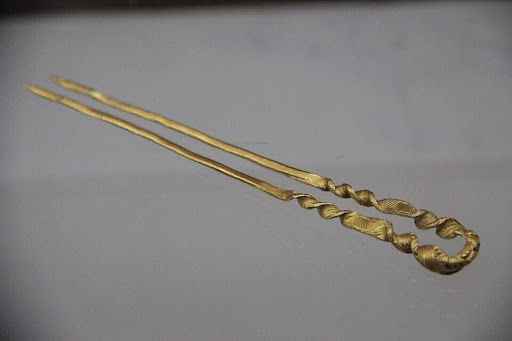
Buyao (步摇)
The name of this type of hairpin literally means ‘step-sway’; fittingly, whenever the wearer walks, the decorations hanging from one end of the buyao will sway and chime in time with their steps. Buyao are typically made of gold, and could have many different elaborate shapes—dragons, phoenixes, flowers, birds, and more. They first originated before the Qin Dynasty, but rose in popularity during the Tang Dynasty.

Santiaozan (三条簪)
This unique type of hairpin is native to Fujian, a province in southern China. Also known as sanbadao (三把刀), it consists of a main hairpin and two hairpins crossing over it, almost like the blades of a propeller. The santiaozan is not just an accessory, though—the three hairpins can be used in self-defense, and are as sharp as swords.
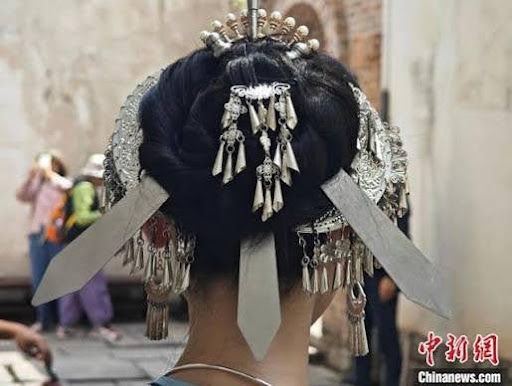
Most of the hairpins detailed in this article originated from the Han Chinese ethnic group, but the santiaozan, according to legend, traces its origins to the ancient Minyue ethnic group that lived in present-day Fujian Province. According to the legend, Minyue women had a tradition of wearing weapons for self-defense. Although we can’t verify for certain if this was the case, historical records indicate that a Fujianese woman used a sword-shaped hairpin as a tool during the late Tang Dynasty. Additionally, women during the Ming Dynasty used hairpins as a method of self-defense against Japanese pirates. Although the custom of wearing santiaozan slowly disappeared after the 1930s, it has been revived today as an object of cultural heritage.
And that's a wrap! Thanks for staying around till the end of this series!


Comments