Hanfu Through the Ages, Part 4: The Song and Ming Dynasties
Last but not least, here's the final installment in the Hanfu Through the Ages series!
Song Dynasty
As opposed to the ostentatiousness of the Tang Dynasty, fashion in the Song Dynasty (960 – 1279 AD) favored simpler clothing. The beizi (背子/褙子)—not to be confused with a homophonous word meaning ‘quilt’—helped create a straight silhouette, making for an understated yet elegant aesthetic. It also became fashionable for women to wear ku (裤), or trousers, without a skirt over them.

For men, the yuanlingpao continued to enjoy popularity. A special variation known as the lanshan (襕衫) was worn exclusively by bureaucrats and scholars. Unlike the regular yuanlingpao, the lanshan had a special seam extending from the bottom of the robe known as henglan (横襕).

On a more unfortunate note, foot binding became popular with the elites during this period. The practice is thought to have originated among court dancers during the Five Dynasties and Ten Kingdoms period (907 - 979 AD) before spreading to upper class women during the Song Dynasty. In the later Ming and Qing Dynasties, foot binding would become even more widespread, to the point where commoners also adopted the practice. It wouldn’t be until 1912, after the founding of the Republic of China, that foot binding was finally banned.
Ming Dynasty
The Ming Dynasty (1368 – 1644 AD) saw the rise of the aoqun (袄裙) for women’s wear, which remains one of the most iconic symbols of the Ming Dynasty today. Similar to the ruqun, it was separated into a top—in this case, the ao, a double-layered jacket, instead of the ru—and a skirt. Unlike the ruqun, however, the top was not tucked into the skirt, instead left to cover the skirt slightly.

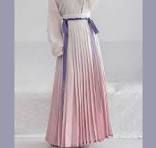
The type of skirt used during the Ming Dynasty differed from previous dynasties as well—usually, it was either the mamianqun (马面裙) or the baidiequn (百迭裙). Both skirts were highly pleated and had flat panels on each side, lending the wearer a formal, austere look. The mamianqun consisted of two panels which overlapped at the front when worn, resulting in a distinctive flap that allowed for ease of movement. On the other hand, the baidiequn was a skirt with a single panel, so the silhouette was much slimmer and the wearer could not move around as easily.

And that's a wrap! Thank you for staying with me on this journey. Coming up next, I'll be explaining why clothing worn during the Qing Dynasty isn't commonly considered hanfu.


Comments