Is Qing Dynasty Clothing Hanfu?
I mentioned in my recent series, Hanfu Through the Ages: A Brief Overview of How Fashion Evolved in Ancient China, that clothing worn during the Qing Dynasty is not considered hanfu. You may recall that the term hanfu refers to the various styles of clothing worn by the Han Chinese people during Ancient and Imperial China. So you may ask, how come Qing Dynasty-style clothing isn’t considered hanfu? Han Chinese people wore it during that time period, after all!
The answer to that question is a bit complicated. Let’s look at some of the history:
The Qing Dynasty (1644–1911) was one of two non-Han Chinese dynasties to rule China. Its ruling house was the Manchu Aisin-Gioro clan, who brought Manchu clothing, or qizhuang (旗装), with them when they defeated the preceding Ming Dynasty. Afterwards, the new dynasty instituted a policy known as Tifayifu (剃发易服)—‘shaving hair and changing clothes’. Han Chinese men had to adopt Manchu clothing and hairstyles under pain of death. So, rather than being a natural evolution of clothing over time, clothing during the Qing Dynasty represented a new ruling class’s effort to establish their authority.
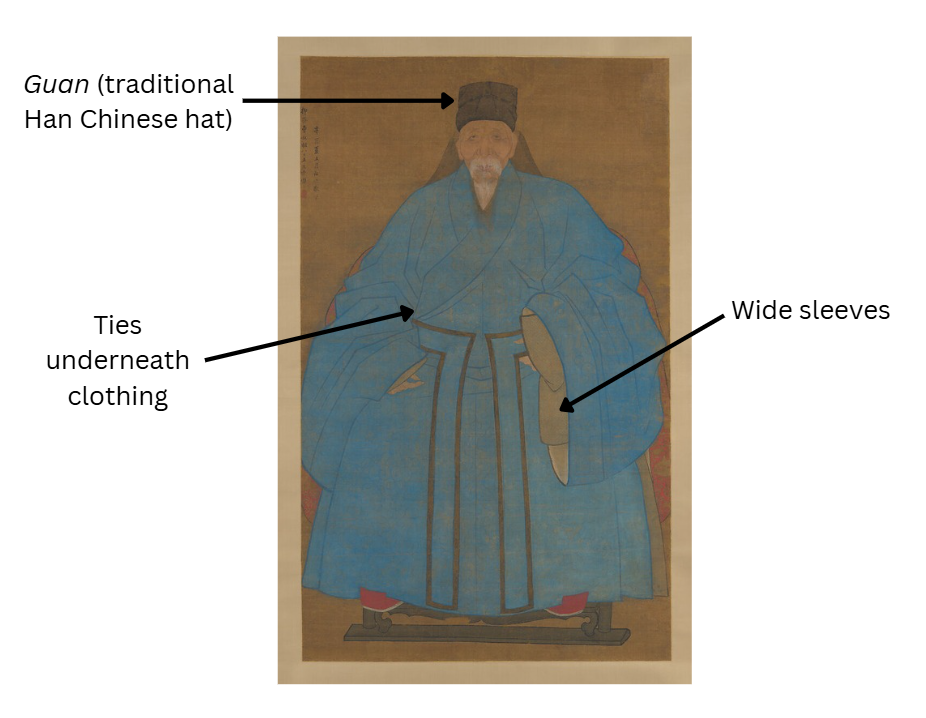
Here’s a table of comparison between clothing during the Ming Dynasty and Qing Dynasty:
Ming Dynasty | Qing Dynasty |
y-shaped, parallel, or round collars | exclusively round collars, with a curved front lapel instead of a straight one |
used ties to fasten clothing | used buttons (pankou) to fasten clothing |
women wore two-piece dresses | women wore one-piece dresses |
wide sleeves | matixiu (‘horse-hoof sleeves’) |
men wore their hair in topknots and had guan as headwear | men wore their hair in queues (shaved forehead + long braid) and wore Mandarin hats |
You can also see these differences more clearly in photographs and portraits:



Comments